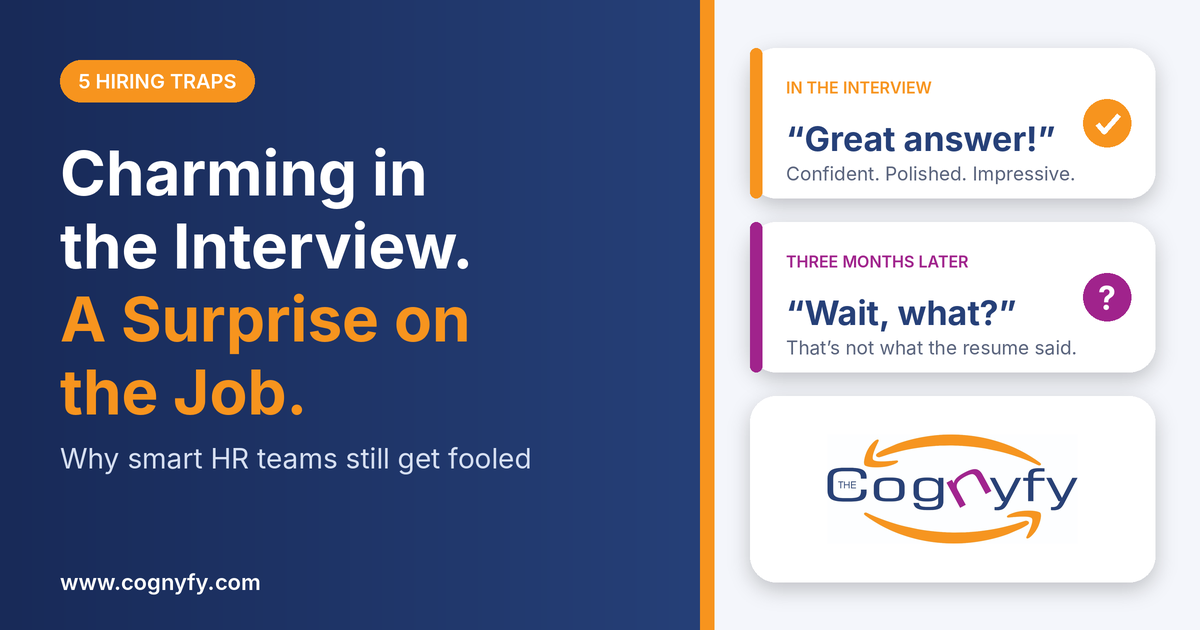
Charming in the Interview. A Surprise on the Job. 5 Traps That Fool Smart HR Teams
Every HR professional has a story like this one.
The candidate walked in confident, answered every question smoothly, and had the panel nodding within ten minutes. Three months later, the same person was struggling, blaming others, or simply gone.
So what happened? Usually it isn’t that HR missed something obvious. It’s that the interview room is a stage, and stages reward performance, not truth.
Smart, experienced teams fall into the same five traps again and again. Knowing them is half the defense.
Trap 1: The Halo Effect
One impressive thing, such as a top college, a famous employer, or a brilliant answer to question one, quietly colors everything else. The panel starts looking for reasons to agree instead of reasons to question.
How to avoid it: Score each skill separately, and score it before the group discusses. If one strength is lighting up your whole impression, slow down and test the other areas on their own.
Trap 2: The Referral Shortcut
“He comes highly recommended” is one of the most dangerous sentences in hiring. A referral tells you someone likes the candidate. It doesn’t tell you the facts on the resume are accurate.
How to avoid it: Treat referrals as an introduction, not a verification. A referred candidate goes through the same checks as everyone else, because fairness is a policy and not a favor.
Trap 3: The Big Brand Name
A famous company on the resume feels like proof. But a brand name doesn’t tell you what the person actually did there, how long they stayed, or why they left.
How to avoid it: Look past the logo. Ask what they owned, what changed because of them, and confirm the details with the employer instead of trusting the company name.
Trap 4: The Deadline Squeeze
The role has been open for six weeks. The manager is frustrated. Leadership is asking for updates. Suddenly “good enough” starts sounding like “great.”
Pressure is when the most expensive mistakes get made, because steps that feel optional on a calm day get skipped on a stressful one.
How to avoid it: Decide your non-negotiable steps before the pressure starts, and write them down. When urgency shows up, the process is already decided, and nobody has to argue for it.
Trap 5: The Gut Feeling
“I just have a good feeling about this one.” Gut instinct is not useless, but it’s often just a polite word for “this person is like me.” It rewards familiarity and punishes difference, and that’s how teams end up less diverse and less effective.
How to avoid it: Let your gut start the conversation, but never let it end the decision. Facts first, feelings second.
The pattern behind all five
Look closely, and every trap has the same root: a good impression is being treated as proof.
An impression is how someone made you feel in an hour. Proof is what the record says about years of work. Good hiring needs both, and only one of them can be checked.
That’s the real purpose of background verification. It isn’t about doubting people. It simply gives HR something firmer than a feeling to stand on, so the final decision is built on facts and not on charm.
A simple habit to start this month
Before your next offer goes out, ask the panel one question: “What are we sure of, and what are we assuming?”
Whatever lands in the second column is your verification list.
Where Cognyfy fits in
At Cognyfy, we help HR teams turn “we think” into “we know.” We handle the background checks, so your team can spend its energy on what only humans can do: understanding people, building teams and making the call.
Want to hire on facts, not just first impressions?
Talk to the Cognyfy team today.
www.cognyfy.com